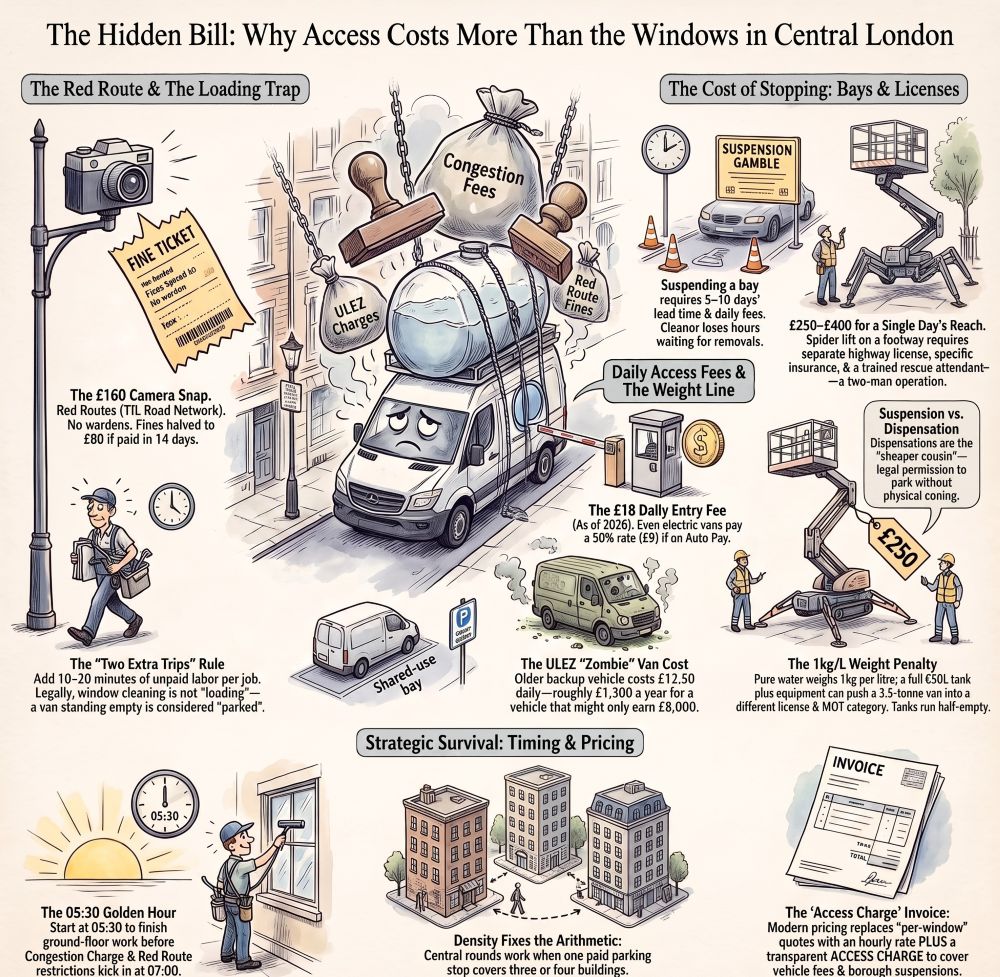
The bill for cleaning forty windows on a Marylebone High Street office is mostly not about the windows. It is about a van, a kerb, and roughly eleven separate ways the city has of taking money off a vehicle that stops moving. I run rounds from Bishopsgate out to Eltham High Street, and the labour rate barely differs between them. Everything else does.
What Does a Red Route Do to a Morning Round?
Red routes are the TfL Road Network – the arterial corridors, something like five per cent of London’s roads carrying about a third of its traffic. Double red lines mean no stopping at any time, for anyone, including a van with a tank in the back and a job forty feet away. Single red lines mean no stopping during the hours on the sign, which in central London is usually most of the day you’d want to work.
Enforcement is camera-led and unforgiving. TfL’s penalty on the red route network sits at £160, halved to £80 if you pay inside fourteen days, and there is no warden to reason with because the ticket arrives in the post from a camera that saw you at 09:14 on Commercial Road. You will not talk your way out of it. Loading exemptions exist in marked bays and at marked kerb chevrons, and they are useful, but the exemption covers continuous loading and unloading – not a vehicle standing empty while its driver is on the fourth floor of a building with a squeegee.
That distinction is the whole thing. Window cleaning is not loading. You unload for four minutes and then work for ninety, and for eighty-six of those minutes your van is parked, legally speaking, wherever it happens to be.
The loading bay that solves half the problem
Shared-use and loading bays off the red route are where a central round lives or dies. Bays on borough roads a street back from the main corridor often permit up to twenty or thirty minutes for loading, longer if they’re pay-by-phone shared use, and the working method that follows is: park legal, walk the kit in on a trolley, return to move the van, walk back. Two extra trips per job, five to ten minutes each.
Nobody pays you for that. It is not in the quote, and it happens four or five times a day on a central round.
When Do You Need a Bay Suspension, and What Does the Borough Charge?
The moment you need the vehicle itself parked directly at the building – a tank van feeding a pole at eighteen metres, or anything involving a MEWP – you are into suspensions and dispensations rather than parking.
Every borough runs its own scheme and prices it differently. Expect a per-bay, per-day charge in the tens of pounds, an administration fee on top, and a lead time that is rarely under five working days and can be ten in Westminster or Kensington and Chelsea during busy periods. Suspend three consecutive bays on a residential street in SW1 for a two-day access job and you have a real line item, and it has to be booked before you’ve confirmed the weather, which means you sometimes pay for a suspension on a day the wind stops you working at height.
If the work needs a cherry picker on the footway rather than in the carriageway, add a separate highways licence from the borough plus evidence of insurance at whatever level they specify, and a traffic management plan for anything that narrows a pedestrian route. A 12-metre spider lift is £250 to £400 a day before the operator, and the operator needs an IPAF card and somebody trained as a rescue attendant standing at the base. That is two men on site to clean windows one man could reach if only the van could stop.
Dispensations are the cheaper cousin: permission to park where you otherwise couldn’t, for a defined period, without the bay being physically coned and signed. Where a borough will grant one, take it.
The signs have to go up, and somebody has to check them
A suspension is only enforceable if the yellow corex notices went out with the required notice period on them. If they didn’t, or if a resident pulled them off overnight, you arrive to find a Volvo in your bay and the borough telling you to ring the removals contractor. I’ve lost two hours on Bermondsey Street to exactly that. The habit worth building is a drive-past the evening before, or a photograph from somebody local.
Is ULEZ Still a Real Cost for a Water-Fed Pole Van?
For most operators, no, and this is where the conversation usually gets lazy. ULEZ covers all London boroughs now at £12.50 a day for non-compliant vehicles, but the standard is Euro 6 for diesel, which every van sold since around September 2016 meets. If you are running a 2019 Transit or a 2021 Vivaro, you pay nothing and you have paid nothing for years.
Where it bites is the old vehicle you kept because it was paid for. A 2014 diesel tipper or a second van used twice a week for gutter work is £12.50 every day it turns a wheel anywhere inside the M25, and £12.50 twice weekly is £1,300 a year for a vehicle that earns maybe eight grand.
The weight line nobody thinks about until they cross it
Pure water is one kilogram a litre. A 650-litre tank filled to the top is 650kg before you count the pole rack, the RO unit, the ladders and a passenger, and a 3.5-tonne van with a payload around 1,100kg gets uncomfortable fast. Cross 3.5 tonnes gross and you are into a different licence category for anyone who passed their test after 1997, different tachograph and MOT considerations, and the Low Emission Zone standards that sit above ULEZ for heavier vehicles.
The practical answer is to run tanks part-filled and refill from a client’s outside tap where you can get one, which in central London you frequently can’t, because the building is an office with no external tap and a facilities manager who wants a risk assessment before you touch a standpipe.
How Much Is the Congestion Charge Costing Per Window?
Since 2 January 2026 the Congestion Charge is £18 a day, up from £15, and the old blanket exemption for electric vehicles has gone – electric vans now get a 50 per cent discount if they’re registered on Auto Pay, so £9 rather than nothing. The zone runs Monday to Friday from 07:00 to 18:00, and from noon to 18:00 at weekends and on bank holidays.
Eighteen pounds sounds trivial against a day’s turnover until you divide it properly. If the zone accounts for two days of your week, that’s £36, plus ULEZ if you’re on an older vehicle, plus whatever the kerb cost you. On a small residential job in Fitzrovia billed at £45, the daily charge is a meaningful share of the gross before anyone has touched a squeegee, and it does not scale down for small jobs. The charge is the same for the van that does one flat as for the van that does eleven offices.
Why the round starts at half past five
The charge begins at 07:00 on weekdays. Red route single-line restrictions typically start at 07:00 or 08:00. Pay-by-phone bays in most central zones don’t begin charging until 08:30 or 09:00.
So there is a window, roughly 05:30 to 07:45, where central London is nearly free to a vehicle and nearly empty of one. Ground-floor and lower-elevation work gets done in it, then the van comes out of the zone before the meter starts, and the rest of the day runs on foot or from a bay a street back. Every established central operator I know works some version of this. It costs you a 04:45 alarm and a first hour of the day in the dark for four months of the year.
Nobody pays you for that either, and it is the single biggest reason central work is a different trade from suburban work rather than the same trade with worse parking.
Should Central Work Be Priced Differently From the Rest of the Round?
It should be priced on a different basis altogether, and here is the opinion I’ll defend: any firm quoting per-window in W1 or EC2 is either subsidising that work from its outer-London round or has not sat down with a calculator. Per-window pricing assumes access is free and time on site is the only variable. In the zone, access is the variable and the windows are almost incidental.
What works is an hourly rate for time on site plus a stated access charge covering the vehicle, so the client can see what they’re paying for. Clients in central London accept this more readily than contractors expect, because every other trade they deal with already prices this way. A plumber attending a flat off Wilton Road does not pretend the parking was free.
The access charge also gives you somewhere honest to put the abort. Bay suspended and coned, van loaded, wind gusting to 25 miles an hour by nine o’clock, and the pole work is off for the day. Somebody has already paid the borough.
Density is the only thing that fixes the arithmetic
The reason a round in Eltham or Blackheath Village can be profitable at a third of the central rate is that the van moves eighty metres between jobs and parks free. Central rounds only work when they’re dense enough that one paid stop covers three or four buildings within a two-minute walk, which is why serious central operators refuse scattered single jobs and turn away work that would look fine on paper.
If you’re a managing agent with buildings in EC2 and you’re using three different firms, put them out to one contractor as a block and ask for the access charge to be shared across the buildings. It’s a smaller invoice for the same work, and it takes money off somebody like me. It also means the man in the van isn’t quietly making up the difference by rushing your second floor.