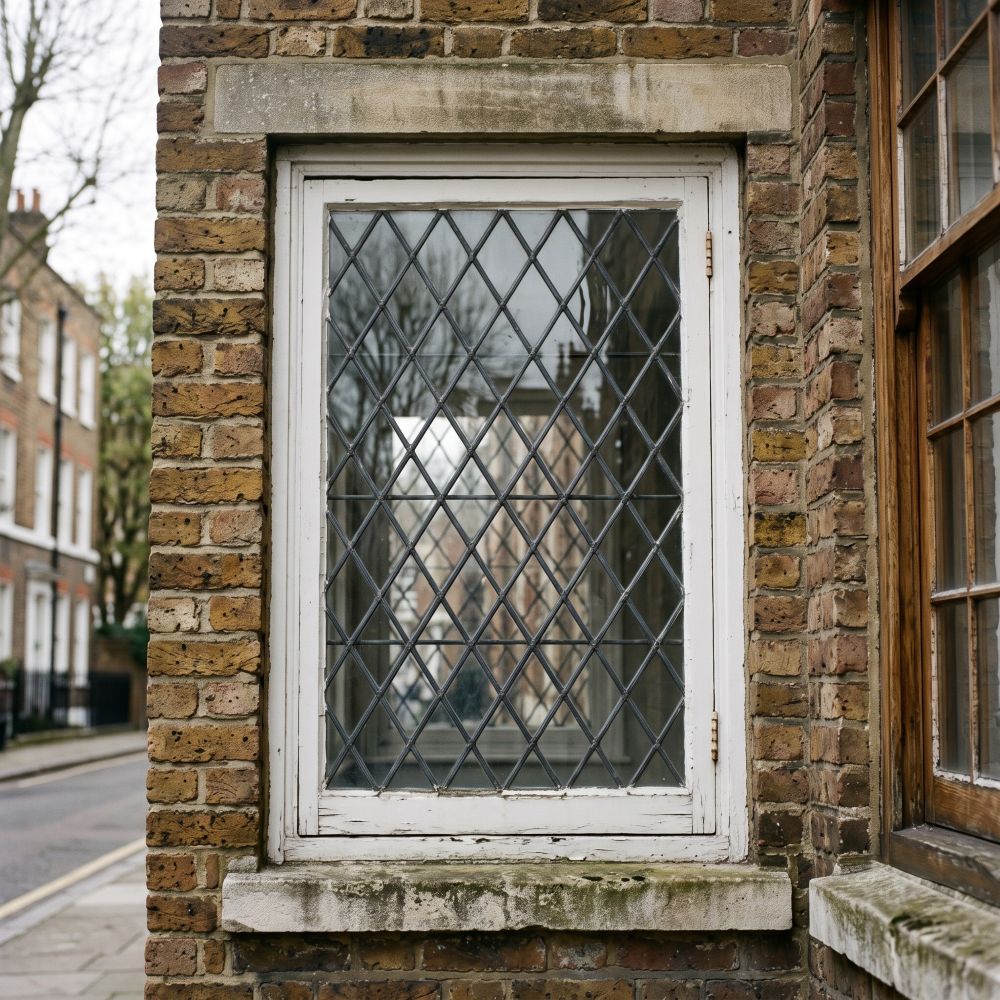
The first leaded light I ever damaged was in a ground-floor bay on Church Row in Hampstead, about nineteen years ago, and it took me four seconds. I put a 12-inch channel across a panel that had bowed maybe 15mm outwards over its life, leaned on it the way you lean on any pane, and heard the sound – a soft tick, like a knuckle – as a solder joint let go behind the glass. Nobody died. The client never noticed and the glazier charged £180. But I have thought about that four seconds on every listed job since, and it shapes everything below.
What Makes Crown Glass Different From the Pane Beside It?
Crown glass was spun. A gather of molten metal on the end of a pontil, opened out and flung round until centrifugal force threw it into a disc up to about 1.5 metres across, then cut into rectangles once cool. The disc has a bullseye in the middle where the rod was, faint concentric ripples running out from it, and a thickness that varies across a single small pane. It went out of general London use in the 1840s, superseded by cylinder glass, so anything still holding crown in a Bloomsbury or Spitalfields house has survived roughly a hundred and eighty years of sash cords, bombs, careless decorators and previous window cleaners.
It is also thin, and unevenly so. Often under 2mm at the outer edge of the disc, and soda-lime glass of that period is softer than anything made after the 1950s. Press a scraper against it at the wrong angle and it does not resist you the way modern float does.
Then there’s what age has done to the surface. Old glass weathers – alkali leaches out of the top few microns, the surface pits and takes on that faint iridescent bloom you see on very old panes, particularly on the weather face of a south elevation. That bloom is not dirt. It cannot be cleaned off, and anything aggressive enough to shift it is removing the glass itself.
Telling crown from cylinder from a 1990s replacement, standing on the path
Look along the pane at a raking angle with something straight behind it – a downpipe or the edge of a door frame. Crown puts a slow wobble into that line and the ripple curves. Cylinder glass distorts too, but the distortion runs in straight bands parallel with the way the cylinder was flattened. Modern float gives you a line that stays a line. On a five-panel Georgian sash in a listed terrace you’ll frequently find two originals and three replacements, and it matters, because the replacements are the only ones I’ll take a blade to.
Why Does Ordinary Glass Cleaner Wreck Lead Cames?
Lead is chemically sociable in a way most people don’t expect from a metal that sits on a roof for two centuries. It builds a stable grey-white patina of lead carbonate that protects everything underneath, and a good part of conserving a leaded light is leaving that patina where it is.
Acetic acid strips it. So the trick you read on forums – white vinegar and newspaper, wonderful on plain glass, cheap and effective – is close to the worst thing you can put on a leaded panel. It attacks the came directly, brightens it, and starts the corrosion cycle again from bare metal. Ammonia-based proprietary cleaners are barely better, and the strong alkaline traffic-film removers some firms carry in the van for uPVC will haze the surface of old glass and lift the cement bedding out of the came flanges.
Leave it.
What goes on the cloth, and what stays in the van
A few drops of a neutral non-ionic detergent in demineralised water, applied on a damp swab rather than a wet one, worked pane by pane and blotted off with lint-free cotton. Conservators use Synperonic A7 for this and it costs nothing to buy a litre. No scrim across the lead, because scrim catches on solder joints and copper ties and pulls them. No squeegee rubber running over a came at speed. On the internal face of a Highgate house off Pond Square I once spent two hours on eight panels of Victorian coloured margin lights, and two hours was the right amount of time for eight panels.
What Happens When You Put Pressure on a Bowed Panel?
Leaded lights fail in a predictable order. The cement or putty bedded between glass and lead perishes first, usually within sixty or seventy years, which lets each quarry rattle slightly in its came. Then the panel starts to bow under its own weight, because lead creeps – it deforms slowly and permanently under sustained load, and a panel taller than about 450mm without support will belly outwards over decades. Then the solder joints at the intersections take stresses they were never meant to carry, and one of them goes.
Every one of those stages is made worse by hand pressure. The squeegee is the obvious offender, but so is leaning a palm on the glass to steady yourself, and so is a water-fed pole brush pushed against a first-floor panel at fifteen litres an hour, which will drive water straight through perished cement into the room and onto the sill below. I have seen a Georgian window in Spitalfields with a tidemark on the internal shutter panelling caused entirely by a pole man doing his best.
Saddle bars, ferramenta and the copper ties nobody looks at
The bars spanning the back of a leaded light are the structure. Wrought or mild steel in most London domestic work, let into the timber or stone on either side, with copper wire ties soldered to the came at intervals and twisted round the bar. Those ties are what stops the belly becoming a collapse.
Check them before you touch the glass. If the bar is rusting it will be jacking outwards and putting the panel into tension, and if half the ties have snapped or been cut off by a decorator, the panel is only standing because it hasn’t been asked to do anything yet. You are the one asking it to do something that day. On a Fournier Street window with six broken ties I’ve cleaned the outside and declined the inside, and told the owner why in writing.
Does Grade II Status Change How the Job Gets Quoted?
Routine cleaning is maintenance. Nobody needs consent to wash a window. Repair or replacement of historic glazing in a listed building is a different animal altogether and can require listed building consent from the borough, so the practical rule is that the moment a job stops being cleaning and starts being fixing, it leaves my hands and goes to a conservation-accredited glazier and the conservation officer.
Who you ring when it stops being a cleaning job
The tell is movement. If a quarry rocks under light finger pressure, if there’s daylight visible along a came flange, if the panel has gone opaque with old cement dust between the glass and the lead, that is a repair conversation and not a cleaning one. Same for anything where the timber or stone surround has failed around the panel. I take photographs, send them to the owner, and give them the name of a leaded light specialist who works on listed fabric – and then I clean the windows that are sound and leave that one until it’s been dealt with. Borough conservation teams are generally easier to talk to than people expect, and they would far rather hear from somebody early.
Where it changes the quote is time and liability. A plain sash elevation might be four minutes a window. Eight leaded panels with original glass, hand-cleaned and blotted, is most of a morning, and the insurance position on breaking irreplaceable glass is not the same as the position on breaking a £60 double-glazed unit.
Here’s the opinion, and I’ll defend it: most firms quoting listed properties in London are pricing leaded lights at the plain-glass rate because they’ve never been shown the difference, and if you accept that price you are being quoted by somebody who intends to work fast. On Camberwell Grove I’ve followed three separate outfits who all left the same signature – bright shiny lead, streaked cement lines and a beautiful finish that will look ten years older by the next visit.
When Is Doing Almost Nothing the Right Answer?
Often. A leaded panel on a sheltered elevation needs dry dusting with a soft brush and a wet clean perhaps once a year, and there are windows in Forty Hill and out along the Enfield edge where I’ve talked owners down from quarterly to twice-yearly and the glass looks better for it. Every wet clean is a small mechanical event: water at the cement lines, cloth dragging against solder, and a ladder resting somewhere on the reveal while you do it. Twelve of them do more damage than the London air does.
Leave it alone through frost, too. Cement bedding that’s holding water will lift when it freezes and thaws, and washing a north-facing leaded light in February is asking for it.
The grey streaks running down onto the cill
One more thing that gets blamed on cleaners unfairly. Rainwater running off lead came picks up carbonate and carries it down the glass and onto the stone below, which is why you get those pale grey vertical tracks on a Portland cill under an old leaded window. Scrub the cill hard enough to shift them and you open the stone surface, which makes the next lot worse.
So: soft brush, plain water, accept about seventy per cent, come back in six months.
I’d rather write that than pretend I can make a 1790s window look like it came out of a factory in Peterborough last Tuesday. Some of the best-preserved glass in London has stayed that way because a succession of people decided not to touch it, and there is a version of this trade where the skill is knowing which windows those are. The bullseye in the bottom left pane on Church Row is still there, incidentally. Somebody in 1830 thought it was a defect worth using anyway.